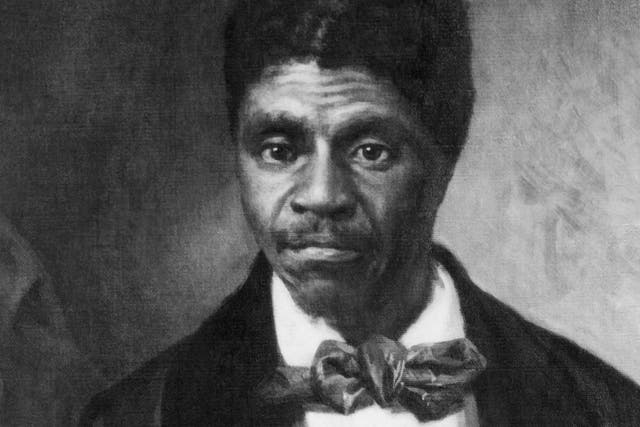
The Dred Scott case, also known as Dred Scott v. Sandford, was a decade-long fight for freedom by a Black enslaved man named Dred Scott. The case persisted through several courts and ultimately reached the U.S. Supreme Court. In 1857, the nation's top court ruled that living in a free state and territory did not entitle Dred Scott to his freedom because, as an enslaved man, he was not a citizen, but essentially another person's property. The court's decision incensed abolitionists, gave momentum to the anti-slavery movement and served as a stepping stone to the Civil War.
Dred Scott was born into slavery around 1799 in Southampton County, Virginia. In 1818, he moved with his owner Peter Blow to Alabama, then in 1830 he moved to St. Louis, Missouri—both slave states—where Peter ran a boarding house.
Dred Scott CaseAfter Blow died in 1832, army surgeon Dr. John Emerson purchased Scott and eventually took him to Illinois, a free state, and then to Fort Snelling in Wisconsin Territory where the Missouri Compromise had outlawed slavery. There, Scott married Harriet Robinson, also enslaved, in a rare civil ceremony; her owner transferred ownership of Harriet to Emerson.
In late 1837, Emerson returned to St. Louis but left Dred and Harriet Scott behind and hired them out. Emerson then moved to Louisiana, a slave state, where he met and married Eliza (Irene) Sandford in February 1838; Dred Scott soon joined them.
The Civil War was a conflict many years in the making.
Pro‑ and Anti‑Slavery Factions in Congress When the Missouri Territory first applied for statehood in 1818, it was clear that many in the territory wanted to allow slavery in the new state. Part of the more than 800,000 square miles bought from France in the Louisiana Purchase of 1803, Missouri was known as the Louisiana […]
What Is an Abolitionist? An abolitionist, as the name implies, is a person who sought to abolish slavery during the 19th century. More specifically, these individuals sought the immediate and full emancipation of all enslaved people. Most early abolitionists were white, religious Americans, but some of the most prominent leaders of the movement were also […]
Since Dred and Harriet Scott had lived in Illinois and the Wisconsin Territory — both free domains — they hoped they had a persuasive case. When they went to trial on June 30, 1847, however, the court ruled against them on a technicality and the judge granted a retrial.
The Scotts went to trial again in January 1850 and won their freedom. Irene appealed the case to the Missouri Supreme Court which combined Dred and Harriet’s cases and reversed the lower court’s decision in 1852, making Dred Scott and his family enslaved again.
In November 1853, Scott filed a federal lawsuit with the United States Circuit Court for the District of Missouri. By this time, Irene had transferred Scott and his family to her brother, John Sandford (although it was determined later that she retained ownership). On May 15, 1854, the federal court heard Dred Scott v. Sandford and ruled against Scott, holding him and his family in slavery.
In December 1854, Scott appealed his case to the United States Supreme Court. The trial began on February 11, 1856. By this time, the case had gained notoriety and Scott received support from many abolitionists, including powerful politicians and high-profile attorneys. But on March 6, 1857, in the infamous Dred Scott decision, Scott lost his fight for freedom again.
Roger Taney was born into the southern aristocracy and became the fifth Chief Justice of the United States Supreme Court.
Taney became best known for writing the final majority opinion in Dred Scott v. Sandford, which said that all people of African descent, free or enslaved, were not United States citizens and therefore had no right to sue in federal court. In addition, he wrote that the Fifth Amendment protected slave owner rights because enslaved workers were their legal property.
The decision also argued that the Missouri Compromise legislation — passed to balance the power between slave and non-slave states — was unconstitutional. In effect, this meant that Congress had no power to prevent the spread of slavery.
Despite Taney’s long tenure as a Supreme Court justice, people vilified him for his role in the Dred Scott v. Sandford decision. In an ironic historical footnote, Taney would later swear in Abraham Lincoln, the "Great Emancipator," as president of the United States in 1861.
By the time the U.S. Supreme Court handed down its Dred Scott decision, Irene had married her second husband, Calvin Chaffee, a U.S. congressman and abolitionist. Upset upon learning his wife still owned the most infamous slave of the time, he sold Scott and his family to Taylor Blow, the son of Peter Blow, Scott’s original owner.
Taylor freed Scott and his family on May 26, 1857. Scott found work as a porter in a St. Louis hotel, but didn’t live long as a free man. At about 59 years of age, Scott died from tuberculosis on September 17, 1858.
The Dred Scott Decision outraged abolitionists, who saw the Supreme Court’s ruling as a way to stop debate about slavery in the territories. The divide between North and South over slavery grew and culminated in the secession of southern states from the Union and the creation of the Confederate States of America. The Emancipation Proclamation of September 22, 1862 freed enslaved people living in the Confederacy, but it would be another three years until Congress passed the 13th Amendment abolishing slavery in the United States.
Watch acclaimed Black History documentaries on HISTORY Vault.
Missouri State Archives: Missouri’s Dred Scott Case, 1846-1857. Missouri Digital Heritage.
Primary Documents in American History: Dred Scott v. Sandford. The Library of Congress.
Roger B. Taney. United States Senate.
The Dred Scott Case. National Park Service.
HISTORY.com works with a wide range of writers and editors to create accurate and informative content. All articles are regularly reviewed and updated by the HISTORY.com team. Articles with the “HISTORY.com Editors” byline have been written or edited by the HISTORY.com editors, including Amanda Onion, Missy Sullivan, Matt Mullen and Christian Zapata.
We strive for accuracy and fairness. But if you see something that doesn't look right, click here to contact us! HISTORY reviews and updates its content regularly to ensure it is complete and accurate.
Get HISTORY’s most fascinating stories delivered to your inbox three times a week.
By submitting your information, you agree to receive emails from HISTORY and A+E Networks. You can opt out at any time. You must be 16 years or older and a resident of the United States.
